Dijkstras Algorithm — Algorithm Visualization & Coding Challenge
Choose Your Learning Path
How would you like to learn today?
Visualize algorithms in real time, explore them step by step, or challenge yourself with a test.Choose a path to focus—or scroll down to preview all options.
🧠 Active Learning
Visualize the algorithm step-by-step with interactive animations in real time.
📖 Passive Learning
Read the full explanation, examples, and starter code at your own pace.
🎯 Challenge Mode
Drag and arrange the algorithm steps in the correct execution order.
🧠 Select Active to activate
Watch algorithms run step by step.
Follow every state change, comparison, and transformation as the execution unfolds in real time.
📖 Select Passive to activate
Understanding Dijkstras Algorithm
Detailed explanation and reference materialsProblem Overview
Dijkstra’s Algorithm (Shortest Path)
Dijkstra’s algorithm is a classic method for finding the shortest path from a starting node to every other node in a weighted graph (with non-negative edge weights).
How It Works
- Initialization
- Distance Map: Create an object
distwhere every node’s distance is set to infinity (∞), except the start node which is set to 0. - Priority Queue: Use a priority queue (or min-heap) to store nodes ordered by their current shortest distance.
- Previous Map: Optionally, maintain a
previousmap to keep track of the best preceding node for each node (useful for reconstructing the shortest path).
- Distance Map: Create an object
- Main Loop
While the priority queue is not empty:- Extract Minimum: Remove the node
uwith the smallest distance from the queue. - Relaxation: For each neighbour
vofu:- Compute an alternative distance:
alt = dist[u] + weight(u, v) - If
altis less thandist[v]:- Update
dist[v]toalt. - Set
previous[v]tou. - Add or update
vin the priority queue with the new distance.
- Update
- Compute an alternative distance:
- Extract Minimum: Remove the node
- Result Extraction
- After processing, the
distobject contains the shortest distances from the start node to every other node. - To reconstruct the shortest path from the start node to a target node, backtrack using the
previousmap.
- After processing, the
Example Graph
Consider the following graph:
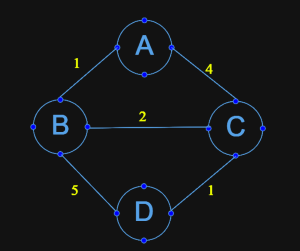
- Edges:
- A → B (weight = 1)
- A → C (weight = 4)
- B → C (weight = 2)
- B → D (weight = 5)
- C → D (weight = 1)
Goal: Find the shortest path from node A to node D.
Step-by-Step Execution
- Initialization:
dist = { A: 0, B: ∞, C: ∞, D: ∞ }previous = {}- Priority Queue:
[(A, 0)]
- Processing Node A:
- Dequeue A (distance = 0).
- For neighbour B:
alt = 0 + 1 = 1→ Updatedist[B] = 1,previous[B] = A.
- For neighbour C:
alt = 0 + 4 = 4→ Updatedist[C] = 4,previous[C] = A.
- Queue becomes:
[(B, 1), (C, 4)].
- Processing Node B:
- Dequeue B (distance = 1).
- For neighbour C:
alt = 1 + 2 = 3→ Updatedist[C] = 3,previous[C] = B.
- For neighbour D:
alt = 1 + 5 = 6→ Updatedist[D] = 6,previous[D] = B.
- Queue becomes:
[(C, 3), (C, 4), (D, 6)]
(Duplicates in the queue are handled appropriately in a proper priority queue implementation.)
- Processing Node C:
- Dequeue C (distance = 3).
- For neighbour D:
alt = 3 + 1 = 4→ Updatedist[D] = 4,previous[D] = C.
- Queue becomes:
[(D, 4), (D, 6)].
- Processing Node D:
- Dequeue D (distance = 4).
- D has no neighbours needing updates.
- The queue is now empty.
- Reconstructing the Shortest Path from A to D:
- Start at D:
previous[D] = C - Then C:
previous[C] = B - Then B:
previous[B] = A - Path: A → B → C → D with a total distance of 4.
- Start at D:
Starter Code
🎯 Select Challenge to activate
Think & Arrange, Don't Just Copy-Paste
Drag and arrange the algorithm steps in the correct execution order instead of spending time typing code letter by letter.
Arrange the Algorithm Correctly 🧩
The algorithm is divided into three logical parts. Carefully rearrange each section in the correct order to form a complete and valid solution.
Understand Below AlgorithmOR
Don't Know Current Algorithm ?
Green text means the instruction is placed in the correct position.
Red text means the instruction is in the wrong position.
Instructions with the same background color indicate particular blocks start and end.
A tick mark means the instruction is correct and locked.
🔒 Locked steps cannot be moved. Only unlocked steps are draggable.
🔊 Enable sound for swap feedback and completion effects.