Breadth First Search — Algorithm Visualization & Coding Challenge
Choose Your Learning Path
How would you like to learn today?
Visualize algorithms in real time, explore them step by step, or challenge yourself with a test.Choose a path to focus—or scroll down to preview all options.
🧠 Active Learning
Visualize the algorithm step-by-step with interactive animations in real time.
📖 Passive Learning
Read the full explanation, examples, and starter code at your own pace.
🎯 Challenge Mode
Drag and arrange the algorithm steps in the correct execution order.
🧠 Select Active to activate
Watch algorithms run step by step.
Follow every state change, comparison, and transformation as the execution unfolds in real time.
📖 Select Passive to activate
Understanding Breadth First Search
Detailed explanation and reference materialsProblem Overview
Breadth-First Search (BFS) Explained
Breadth-First Search (BFS) is a fundamental graph traversal algorithm. It explores the graph level by level, starting from a given source node and expanding outwards to all its neighbours before moving on to the next level.
Example:
INPUT :
[
[0, 1, 1, 0],
[0, 0, 1, 0],
[1, 0, 0, 1],
[0, 0, 0, 1]
] , 2
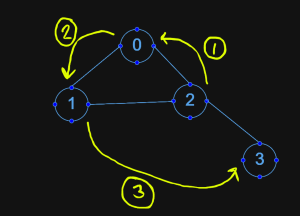
OUTPUT:
2 -> 0 -> 1 -> 3
Key Concepts
- Graph Structure:
BFS works on graphs (bothdirectedandundirected) as well as trees. - Level-Order Traversal:
Nodes are visited in order of their distance from the starting node (i.e., by increasing number of edges). - Queue Data Structure:
BFS uses a FIFO (first-in, first-out) queue to keep track of nodes to visit next.
How BFS Works
- Initialization:
- Mark the starting node as visited.
- Enqueue the starting node.
- Iteration:
- Dequeue a node from the front of the queue.
- Process the current node (e.g., record its value).
- For each unvisited neighbour of the current node:
- Mark the neighbour as visited.
- Enqueue the neighbour.
- Termination:
- Repeat the iteration until the queue is empty. At this point, all reachable nodes from the starting node have been visited.
Time and Space Complexity
Time Complexity: O(V + E)
- V = number of vertices
- E = number of edges
- Every vertex and edge is processed once.
Space Complexity: O(V)
- In the worst case, the queue holds all vertices in the graph.
Applications of BFS
- Shortest Path:
BFS is ideal for finding the shortest path in unweighted graphs. - Level Order Traversal:
In trees, BFS performs a level order traversal. - Connected Components:
BFS can help determine the connected components in a graph. - Web Crawlers:
Used to explore the web layer by layer starting from a seed URL.
Starter Code
🎯 Select Challenge to activate
Think & Arrange, Don't Just Copy-Paste
Drag and arrange the algorithm steps in the correct execution order instead of spending time typing code letter by letter.
Arrange the Algorithm Correctly 🧩
The algorithm is divided into three logical parts. Carefully rearrange each section in the correct order to form a complete and valid solution.
Understand Below AlgorithmOR
Don't Know Current Algorithm ?
Green text means the instruction is placed in the correct position.
Red text means the instruction is in the wrong position.
Instructions with the same background color indicate particular blocks start and end.
A tick mark means the instruction is correct and locked.
🔒 Locked steps cannot be moved. Only unlocked steps are draggable.
🔊 Enable sound for swap feedback and completion effects.