Map of Highest Peak — Algorithm Visualization & Coding Challenge
Choose Your Learning Path
How would you like to learn today?
Visualize algorithms in real time, explore them step by step, or challenge yourself with a test.Choose a path to focus—or scroll down to preview all options.
🧠 Active Learning
Visualize the algorithm step-by-step with interactive animations in real time.
📖 Passive Learning
Read the full explanation, examples, and starter code at your own pace.
🎯 Challenge Mode
Drag and arrange the algorithm steps in the correct execution order.
🧠 Select Active to activate
Watch algorithms run step by step.
Follow every state change, comparison, and transformation as the execution unfolds in real time.
📖 Select Passive to activate
Understanding Map of Highest Peak
Detailed explanation and reference materialsProblem Overview
Leetcode Problem: Map of Highest Peak
Problem Description
You are given a matrix isWater of size m x n where:
isWater[i][j] == 0: This cell represents land.isWater[i][j] == 1: This cell represents water.
The input specifies where water and land cells are located, but it does not specify the heights of the land cells. Your task is to assign heights to the land cells following these rules:
- Water cells must have a height of
0. - Any two adjacent cells (north, south, east, west) must differ in height by at most
1. This ensures a smooth gradient of heights between neighboring cells. - Assign heights to land cells in a way that maximizes the highest height in the matrix.
Your goal is to return a matrix height of size m x n where height[i][j] represents the height of cell (i, j) while following the rules.
Examples
Example 1:
Input:
isWater = [[0,1], [0,0]]
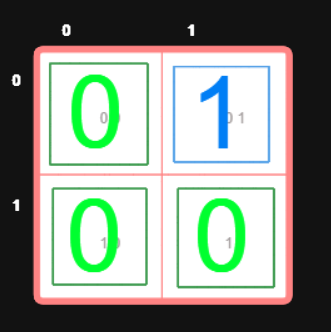 Output:
height = [[1,0], [2,1]]
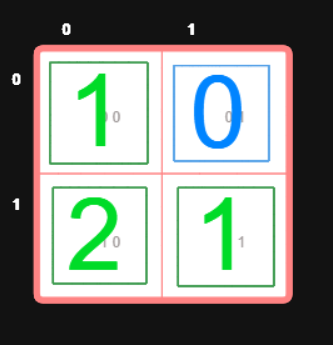 Explanation:
- The water cell at
(0,1)has height0(rule #1). - Its adjacent land cells
(0,0)and(1,1)have heights1and1, differing by exactly1(rule #2). - The bottom-left cell
(1,0)has height2, which is the highest possible height while meeting the adjacency rule (rule #3).
Example 2:
Input:
isWater = [[0,0,1], [1,0,0], [0,0,0]]
Output:
height = [[1,1,0], [0,1,1], [1,2,2]]
Explanation:
- All water cells
(0,2)and(1,0)have height0. - Land cells around the water are assigned increasing heights, forming a gradient that satisfies the adjacency rule.
- The highest height in this matrix is
2.
Approach to Solve the Problem
1.Initialization:
Start by creating the height matrix where all cells are initially unassigned. Assign 0 to all water cells since water must have height 0.
- Use BFS (Breadth-First Search):
Perform a multi-source BFS starting from all water cells (height = 0) simultaneously.- Push all water cells into a queue.
- As you process each cell, assign heights to neighboring land cells if they are not already assigned.
- Ensure the height of a neighboring cell is exactly
1more than the current cell’s height.
- Propagation of Heights:
The BFS will propagate heights outward from water cells.- Cells farther from water will have higher heights.
- This ensures that the maximum height is reached at the farthest land cells.
- Output the Matrix:
Once BFS completes, theheightmatrix will be filled, and the maximum height will naturally be achieved.
Key Observations
- Water cells act as the starting point (height
0) for spreading heights to the surrounding land. - The farther a land cell is from water, the greater its height, due to the adjacency constraint.
- Using BFS ensures that each cell is processed in the shortest possible path from the water, which guarantees that heights are maximized correctly.
Constraints
- Matrix size:
1 <= m, n <= 1000.
This ensures the algorithm must be efficient to handle large matrices. - At least one water cell exists (
isWatercontains at least one1).
Why BFS?
- BFS is ideal for problems requiring shortest-path propagation, like this one, where heights depend on the shortest distance from water.
- It processes all cells layer by layer, ensuring heights increase uniformly from water.
Complexity
- Time Complexity:
- BFS processes each cell exactly once, so the time complexity is O(m * n).
- Space Complexity:
- The queue used in BFS requires space proportional to the number of cells, which is also O(m * n).
This ensures the solution is efficient and scalable for large inputs.
— Written by Saurabh Patil • B.Tech CSE • Software DeveloperStarter Code
🎯 Select Challenge to activate
Think & Arrange, Don't Just Copy-Paste
Drag and arrange the algorithm steps in the correct execution order instead of spending time typing code letter by letter.
Arrange the Algorithm Correctly 🧩
The algorithm is divided into three logical parts. Carefully rearrange each section in the correct order to form a complete and valid solution.
Understand Below AlgorithmOR
Don't Know Current Algorithm ?
Green text means the instruction is placed in the correct position.
Red text means the instruction is in the wrong position.
Instructions with the same background color indicate particular blocks start and end.
A tick mark means the instruction is correct and locked.
🔒 Locked steps cannot be moved. Only unlocked steps are draggable.
🔊 Enable sound for swap feedback and completion effects.