Get Biggest Three Rhombus Sums in a Grid — Algorithm Visualization & Coding Challenge
Choose Your Learning Path
How would you like to learn today?
Visualize algorithms in real time, explore them step by step, or challenge yourself with a test.Choose a path to focus—or scroll down to preview all options.
🧠 Active Learning
Visualize the algorithm step-by-step with interactive animations in real time.
📖 Passive Learning
Read the full explanation, examples, and starter code at your own pace.
🎯 Challenge Mode
Drag and arrange the algorithm steps in the correct execution order.
🧠 Select Active to activate
Watch algorithms run step by step.
Follow every state change, comparison, and transformation as the execution unfolds in real time.
📖 Select Passive to activate
Understanding Get Biggest Three Rhombus Sums in a Grid
Detailed explanation and reference materialsProblem Overview
· Get Biggest Three Rhombus Sums in a Grid
Difficulty: Medium | Topics: Matrix, Prefix Sum, Enumeration
You are given an m x n integer matrix grid.
A rhombus sum is the sum of the elements that form the border of a regular rhombus shape in grid. The rhombus must have the shape of a square rotated 45° with each of its corners centered in a grid cell.
Note: A rhombus can have an area of 0, represented by a single cell.
Return the biggest three distinct rhombus sums in the grid in descending order.
If there are fewer than three distinct values, return all of them.
Examples
Example 1
Input:  grid = [[3,4,5,1,3],[3,3,4,2,3],[20,30,200,40,10],[1,5,5,4,1],[4,3,2,2,5]]
Output: [228, 216, 211]
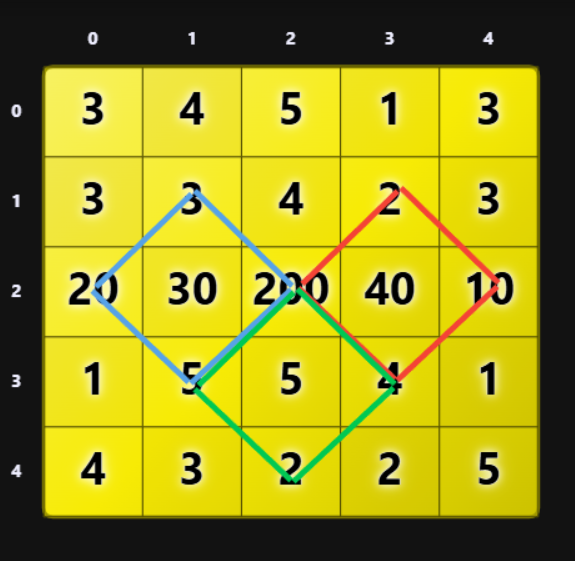
- 🔵 Blue: 20 + 3 + 200 + 5 = 228
- 🔴 Red: 200 + 2 + 10 + 4 = 216
- 🟢 Green: 5 + 200 + 4 + 2 = 211
Example 2
Input:  grid = [[1,2,3],[4,5,6],[7,8,9]]
Output: [20, 9, 8]
- 🔵 Blue: 4 + 2 + 6 + 8 = 20
- 🔴 Red: 9 (area 0 rhombus — bottom right)
- 🟢 Green: 8 (area 0 rhombus — bottom middle)
Example 3
Input:  grid = [[7,7,7]]
Output: [7]
All three possible rhombus sums are identical — return [7].
Constraints
| Parameter | Bound |
|---|---|
m == grid.length | — |
n == grid[i].length | — |
m, n | 1 ≤ m, n ≤ 50 |
grid[i][j] | 1 ≤ value ≤ 10⁵ |
Java Solution
class Solution {
    public int[] getBiggestThree(int[][] grid) {
        int m = grid.length, n = grid[0].length;
        TreeSet<Integer> set = new TreeSet<>();

        // iterate every center cell (r, c) and every radius k
        for (int r = 0; r < m; r++) {
            for (int c = 0; c < n; c++) {
                // radius 0 — single cell
                addToSet(set, grid[r][c]);

                for (int k = 1; r - k >= 0 && r + k < m
                         && c - k >= 0 && c + k < n; k++) {
                    int sum = 0;
                    // top → right (↘)
                    for (int i = 0; i < k; i++)
                        sum += grid[r - k + i][c + i];
                    // right → bottom (↙)
                    for (int i = 0; i < k; i++)
                        sum += grid[r + i][c + k - i];
                    // bottom → left (↖)
                    for (int i = 0; i < k; i++)
                        sum += grid[r + k - i][c - i];
                    // left → top (↗)
                    for (int i = 0; i < k; i++)
                        sum += grid[r - i][c - k + i];
                    addToSet(set, sum);
                }
            }
        }

        int[] res = new int[set.size()];
        int idx = 0;
        for (int val : set.descendingSet())
            res[idx++] = val;
        return res;
    }

    private void addToSet(TreeSet<Integer> set, int val) {
        set.add(val);
        if (set.size() > 3) set.pollFirst(); // keep only top 3
    }
}
Time Complexity: O(m · n · min(m, n))
Space Complexity: O(1) — TreeSet holds at most 3 elements
Starter Code
🎯 Select Challenge to activate
Think & Arrange, Don't Just Copy-Paste
Drag and arrange the algorithm steps in the correct execution order instead of spending time typing code letter by letter.
Arrange the Algorithm Correctly 🧩
The algorithm is divided into three logical parts. Carefully rearrange each section in the correct order to form a complete and valid solution.
Understand Below AlgorithmOR
Don't Know Current Algorithm ?
Green text means the instruction is placed in the correct position.
Red text means the instruction is in the wrong position.
Instructions with the same background color indicate particular blocks start and end.
A tick mark means the instruction is correct and locked.
🔒 Locked steps cannot be moved. Only unlocked steps are draggable.
🔊 Enable sound for swap feedback and completion effects.