Find Elements in a Contaminated Binary Tree — Algorithm Visualization & Coding Challenge
Choose Your Learning Path
How would you like to learn today?
Visualize algorithms in real time, explore them step by step, or challenge yourself with a test.Choose a path to focus—or scroll down to preview all options.
🧠 Active Learning
Visualize the algorithm step-by-step with interactive animations in real time.
📖 Passive Learning
Read the full explanation, examples, and starter code at your own pace.
🎯 Challenge Mode
Drag and arrange the algorithm steps in the correct execution order.
🧠 Select Active to activate
Watch algorithms run step by step.
Follow every state change, comparison, and transformation as the execution unfolds in real time.
📖 Select Passive to activate
Understanding Find Elements in a Contaminated Binary Tree
Detailed explanation and reference materialsProblem Overview
Find Elements in a Contaminated Binary Tree
Problem Statement
You are given a contaminated binary tree where all TreeNode.val have been changed to -1. The tree follows these rules:
- The root node has a value of
0. - If a node has a value
x, then:- Its left child (if exists) will have a value
2 * x + 1. - Its right child (if exists) will have a value
2 * x + 2.
- Its left child (if exists) will have a value
Task
Implement the FindElements class:
FindElements(TreeNode* root): Initializes the object with a contaminated binary tree and recovers it.bool find(int target): Returnstrueif thetargetvalue exists in the recovered binary tree, otherwise returnsfalse.
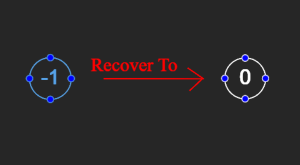
Test Case 1: Single Node Tree
Input
["FindElements","find","find"]
[[[-1]],[0],[1]]
Output
[null,true,false]
Explanation
FindElements findElements = new FindElements([-1]);
findElements.find(0); // returns True (root is always 0)
findElements.find(1); // returns False (no left or right child exists)
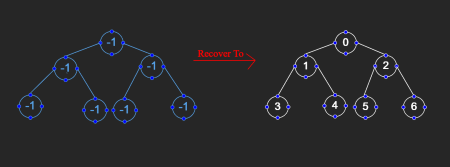
Test Case 2: Complete Binary Tree of Height 3
Input
["FindElements","find","find","find","find","find"]
[[[-1,-1,-1,-1,-1,-1,-1]],[3],[5],[6],[7],[8]]
Output
[null,true,true,true,false,false]
Explanation
FindElements findElements = new FindElements([-1,-1,-1,-1,-1,-1,-1]);
findElements.find(3); // returns True
findElements.find(5); // returns True
findElements.find(6); // returns True
findElements.find(7); // returns False (no node with value 7 exists)
findElements.find(8); // returns False (no node with value 8 exists)
Constraints
- The height of the binary tree is .
- The total number of nodes is in the range .
- will be called at most times.
- .
Approach
- Recover the tree using DFS or BFS:
- Start from the root and assign it
0. - For each node
x, assign its left child2 * x + 1and right child2 * x + 2. - Store these values in a
setorunordered_setfor quick lookup.
- Start from the root and assign it
- Find operation in O(1):
- Use a hash set to store valid node values for
O(1)lookup in thefind()function.
- Use a hash set to store valid node values for
— Written by Saurabh Patil • B.Tech CSE • Software Developer
Starter Code
🎯 Select Challenge to activate
Think & Arrange, Don't Just Copy-Paste
Drag and arrange the algorithm steps in the correct execution order instead of spending time typing code letter by letter.
Arrange the Algorithm Correctly 🧩
The algorithm is divided into three logical parts. Carefully rearrange each section in the correct order to form a complete and valid solution.
Understand Below AlgorithmOR
Don't Know Current Algorithm ?
Green text means the instruction is placed in the correct position.
Red text means the instruction is in the wrong position.
Instructions with the same background color indicate particular blocks start and end.
A tick mark means the instruction is correct and locked.
🔒 Locked steps cannot be moved. Only unlocked steps are draggable.
🔊 Enable sound for swap feedback and completion effects.