Check if Grid can be Cut into Sections — Algorithm Visualization & Coding Challenge
Choose Your Learning Path
How would you like to learn today?
Visualize algorithms in real time, explore them step by step, or challenge yourself with a test.Choose a path to focus—or scroll down to preview all options.
🧠 Active Learning
Visualize the algorithm step-by-step with interactive animations in real time.
📖 Passive Learning
Read the full explanation, examples, and starter code at your own pace.
🎯 Challenge Mode
Drag and arrange the algorithm steps in the correct execution order.
🧠 Select Active to activate
Watch algorithms run step by step.
Follow every state change, comparison, and transformation as the execution unfolds in real time.
📖 Select Passive to activate
Understanding Check if Grid can be Cut into Sections
Detailed explanation and reference materialsProblem Overview
Check if Grid can be Cut into Sections
Problem Description
You are given an integer n representing the dimensions of an n x n grid, with the origin at the bottom-left corner of the grid. You are also given a 2D array of coordinates rectangles, where rectangles[i] = [startx, starty, endx, endy] represents a rectangle on the grid. Each rectangle is defined as follows:
(startx, starty): The bottom-left corner of the rectangle.(endx, endy): The top-right corner of the rectangle.
Conditions to Satisfy:
Your task is to determine if it is possible to make either two horizontal or two vertical cuts on the grid such that:
- Each of the three resulting sections formed by the cuts contains at least one rectangle.
- Every rectangle belongs to exactly one section (i.e., no rectangle spans across a cut).
Return:
trueif such cuts can be made.falseotherwise.
Examples & Explanation
Example 1
Input:
n = 5
rectangles = [[1,0,5,2],[0,2,2,4],[3,2,5,3],[0,4,4,5]]
Grid Representation:
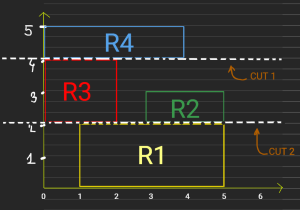
Explanation:
We can make horizontal cuts at y = 2 and y = 4, forming three sections:
- Section 1: Below
y = 2(containsR1) - Section 2: Between
y = 2andy = 4(containsR2andR3) - Section 3: Above
y = 4(containsR4)
Since all conditions are satisfied, output is true.
Constraints
Rectangles do not overlap.
— Written by Saurabh Patil • B.Tech CSE • Software DeveloperStarter Code
🎯 Select Challenge to activate
Think & Arrange, Don't Just Copy-Paste
Drag and arrange the algorithm steps in the correct execution order instead of spending time typing code letter by letter.
Arrange the Algorithm Correctly 🧩
The algorithm is divided into three logical parts. Carefully rearrange each section in the correct order to form a complete and valid solution.
Understand Below AlgorithmOR
Don't Know Current Algorithm ?
Green text means the instruction is placed in the correct position.
Red text means the instruction is in the wrong position.
Instructions with the same background color indicate particular blocks start and end.
A tick mark means the instruction is correct and locked.
🔒 Locked steps cannot be moved. Only unlocked steps are draggable.
🔊 Enable sound for swap feedback and completion effects.